
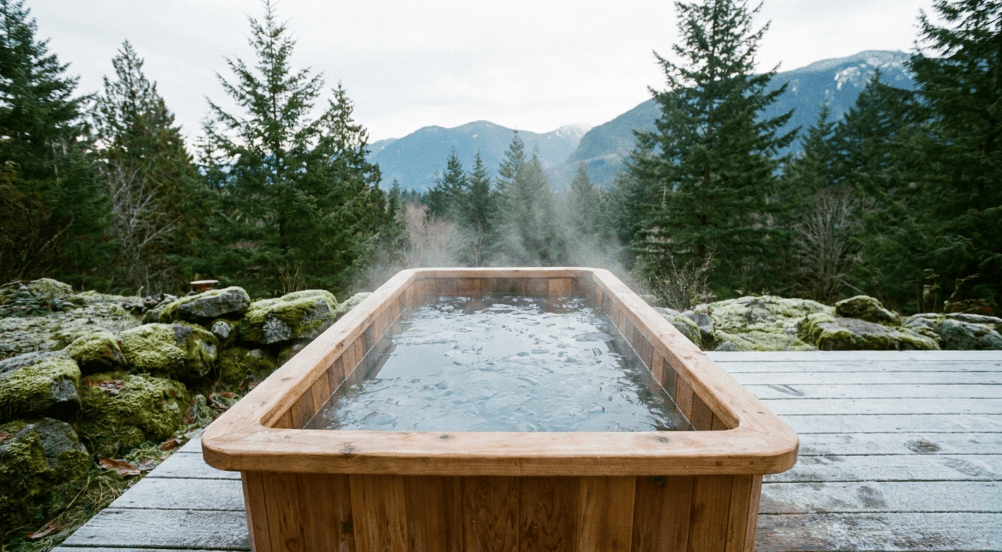
What to Put a Cold Plunge On: Pads, Decks, and Gravel for Beginners
A filled cold plunge is heavy enough that surface choice is not optional. A 100-gallon tank weighs over 800 pounds once full, and larger 200 to 300-gallon units can top 2,500 pounds with a person inside. Reinforced decking, a poured concrete pad, or compacted gravel under interlocking pavers all handle that load safely; loose soil, an unbraced deck, or a standard patio umbrella base do not.
How Much Weight Are You Actually Dealing With?
Water weighs about 8.3 pounds per gallon, so a 100-gallon tub holds roughly 830 pounds before adding the tank shell, a chiller, and whoever climbs in. A 250-gallon stock-tank-style plunge can clear 2,000 pounds at full capacity. That load sits in one fixed footprint rather than spreading out gradually the way a hot tub skirt sometimes does, which is why loose patio pavers set only in sand tend to settle unevenly within a season of daily use.
Rubber Pavers and Interlocking Gym Mats
For a ground-level patio or a garage corner, half-inch rubber pavers or interlocking gym tiles spread the load, shed standing water, and give bare feet traction on a surface that stays wet and cold for most of the year. They sit directly over concrete or a compacted base with no fasteners needed, which makes them the fastest option for a rental or a setup someone plans to move later. The catch is that rubber alone does nothing to correct a sloped or uneven base underneath; it just hides the problem for a while.
Building a Compacted Gravel Pad
A gravel pad is the standard fix for an uneven yard. Excavate four to six inches, lay crushed stone, compact it in stages with a plate compactor, then finish with paver base or pea gravel leveled with a screed board. Done this way it drains fast and will not heave the way bare soil does through a freeze-thaw winter, and it costs far less than a poured slab. Skipping the compaction step is the most common mistake here; loose gravel settles under sustained weight within weeks and leaves the tank sitting at a slight tilt. A rented plate compactor runs $60 to $100 for a half-day, which is a small cost next to the price of the tank itself, and most home centers stock crushed stone and paver base by the ton or the bag depending on how large the pad needs to be. Framing the pad’s edge with landscape timbers or steel edging keeps the gravel from migrating outward over time, which otherwise leaves a shallow dip right where the tank sits after a year or two of foot traffic around it.
What Deck Framing Needs to Handle
Standard residential deck framing, built to code for foot traffic and furniture, is not automatically rated for several hundred pounds of static point load sitting in one spot for months. Joists spaced sixteen inches on center with proper blocking usually handle a mid-size plunge fine, but it is worth confirming joist size and span against the combined weight of tank, water, and chiller before committing, especially on an older deck. Adding blocking or sistering a joist under the plunge’s footprint is cheap compared with a sagging deck board six months later.
Concrete Slabs and Existing Patios
An existing poured patio is close to ideal already: level, load-rated, and it will not shift under repeated fills and drains. The main prep is confirming drainage runs away from the house and checking the slab for cracks that could widen under sustained weight and moisture. Where no slab exists yet, a four-inch reinforced pour dedicated to just the plunge footprint is overkill for most backyards but makes sense for anyone planning a permanent, plumbed-in setup with a fixed drain line.
Placing One Indoors on a Finished Floor
Indoors, the surface question turns into a moisture question more than a weight one. Tile over a concrete slab handles both fine. Wood subfloors need a waterproof barrier underneath and, ideally, a floor drain nearby, since splashes and chiller condensation add up over months of daily use. Once the base is settled, comparing tank capacity against chiller wattage is easier on a full catalog listing than piecing together spec sheets from separate manufacturer sites. SweatDecks lists tank dimensions, gallons, and chiller wattage together on each cold plunge page, which helps when mapping a specific footprint before ordering anything.
Checking Utilities and Property Lines Before You Dig
Anyone planning a gravel pad or a poured slab should call the local utility locating service before breaking ground, since buried electrical, gas, or irrigation lines are common in exactly the spots people pick for a backyard project, and hitting one turns a weekend job into an expensive repair. It is a free call in most areas and takes a few days to get lines marked, so building that lead time into the project schedule matters more than it seems like it should. Setback rules are worth a quick check too. Some municipalities and homeowners associations treat a plumbed-in or permanently plumbed cold plunge similarly to a small pool or spa for permitting purposes, with minimum distances from property lines, fences, or septic fields, even when the unit itself is a freestanding tank rather than an excavated pool. A standalone tank on a gravel pad with no plumbing usually avoids most of this, but it is worth a five-minute call to the local building department before pouring concrete or trenching a drain line, since moving a finished slab afterward costs far more than confirming the rule beforehand would have.
Why a Stable Base Matters for Actually Sticking With It
Cold-water immersion research generally points to consistency of exposure over time mattering more than any single dramatic session, which is part of why a wobbly or tilted setup is a bigger problem than it looks. A tank that leans, drains poorly, or sits on a surface that stays muddy after rain becomes a chore to use, and a plunge that is a chore gets used less. Solid ground underneath is the least glamorous part of the purchase and also the part most likely to determine whether the thing gets used through an entire winter or gets abandoned by March.
Frequently Asked Questions
Can I put a cold plunge directly on grass or dirt? Not for anything permanent. Bare soil compacts unevenly and turns to mud once splashing starts. A gravel pad or paver base solves this over a weekend.
Does a cold plunge need a dedicated drain? Not strictly, but nearby drainage helps. Chillers create condensation and splashing happens every session, so sloping the surface away from the house saves cleanup.
How much extra weight does a chiller add to the footprint? Most standalone chillers add roughly 50 to 150 pounds and sit beside the tank, so plan a second small footprint rather than assuming the tank pad covers everything.
Is a wood deck ever a bad idea for a cold plunge? Only if the framing was never checked. A code-built deck usually handles a mid-size plunge, but older or unknown framing should be inspected first.
References
- Effects of cold-water immersion on health and wellbeing: A systematic review and meta-analysis, PLoS One, 2025
- Effects of cold water immersion after exercise on fatigue recovery and exercise performance: meta analysis, Frontiers in Physiology, 2023
- Cold-water immersion (cryotherapy) for preventing and treating muscle soreness after exercise, Cochrane Database of Systematic Reviews, 2012