
The Promise, the Reality, and the Smart Move: What “Peptides for Women” Actually Means
Here’s a phrase that’s been showing up in your feed lately: “peptides for women.” Sounds official, right? Like a category some medical board sat down and defined. It isn’t. It’s a marketing shelf, and somebody stocked it with five completely unrelated compounds and slapped a bow on top because they know women are a reachable, motivated audience. I wanted to pull the bow off and look at what’s actually on the shelf, because once you see the pieces separately, you stop being an easy sell.
Let’s do this the way I’d want a smart friend to do it for me: the promise first, then the honest reality, then what to actually do about it.
The promise
The pitch goes something like this: one category, five peptides, and each one solves something you’ve probably worried about at some point. Low desire? There’s a peptide. Sagging skin? There’s a peptide. A cranky knee or gut that won’t calm down? Peptide. Want to “glow” or “detox”? Peptide. Curious about metabolism and aging well? You guessed it, a peptide for that too.
The five names that keep surfacing are PT-141 (bremelanotide), GHK-Cu, BPC-157, glutathione, and MOTS-c. The pitch wants you to believe they’re cousins, all cut from the same “peptide science” cloth, all more or less equally legitimate. That’s the promise. It’s tidy, and tidy is exactly the problem.
The reality
Here’s the thing nobody selling the bundle wants you to sit with: these five compounds are not remotely in the same league, evidence-wise. Some have real trials behind them. Some have almost nothing. Let me walk you through each one honestly, because you deserve to know what you’re actually looking at before anyone asks for your credit card.
PT-141 (bremelanotide) works on brain pathways tied to desire and arousal, not blood flow like the pills you’ve heard of. This is the one compound in the whole bundle that actually cleared FDA approval, and I want you to notice how narrow that approval is. In 2019 the FDA approved bremelanotide, sold as Vyleesi, specifically for premenopausal women with acquired, generalized hypoactive sexual desire disorder: low desire that causes real distress and isn’t explained by something else going on medically, psychiatrically, or relationally [2]. That approval came from two large randomized, placebo-controlled Phase 3 trials, called RECONNECT, involving roughly 1,247 premenopausal women with a mean age around 39. The drug produced statistically significant improvements in desire and meaningfully reduced the distress that comes with low desire, compared with placebo [1]. Real effect, but modest, not a switch that flips desire on, and the common side effects were nausea, flushing, and headache [1]. It is not approved for general “low libido,” not for postmenopausal women, and not for men.
Glutathione, your body’s own main antioxidant, gets marketed to women for skin brightening and vague “detox” claims. It’s actually been tested in people for skin lightening, which puts it a step ahead of some others here. But a review of three randomized controlled trials found it “not beneficial enough”: it only worked in some body areas and age groups, and the effect didn’t last [5]. One of the three trials actually came out against it. So oral glutathione seems well tolerated, but the “glow from within” promise is weaker and more inconsistent than the marketing lets on.
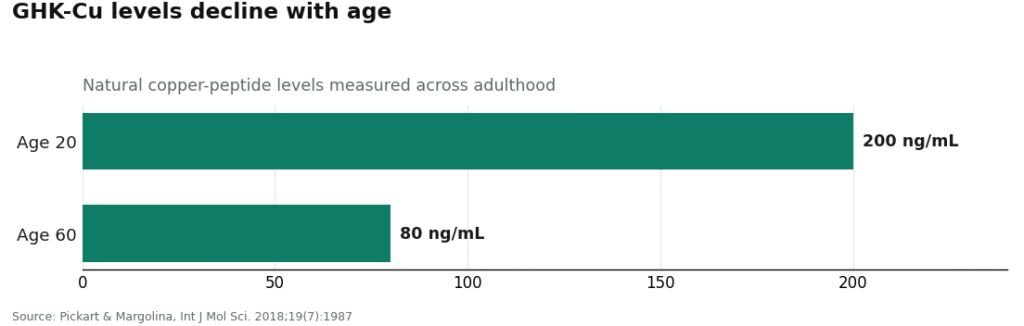
GHK-Cu is a copper-binding tripeptide your body already makes, and it shows up in serums aimed at firmness and fine lines. The foundational review here describes it stimulating collagen and supporting wound repair, with cosmetic studies linking it to improvements in skin laxity, elasticity, and the look of fine lines [3]. It also notes something genuinely interesting: natural GHK levels drop with age, from around 200 ng/mL at age 20 down to about 80 ng/mL by age 60 [3]. That’s a real, measurable decline, and it’s part of why this peptide gets so much cosmetic attention. But read the fine print: much of the strongest support is mechanistic and cosmetic, not from big clinical trials proving a drug-level claim. Topical GHK-Cu for skin is a reasonable, well-tolerated cosmetic choice. Injectable GHK-Cu sold for systemic “anti-aging” is a different animal with far less human evidence behind it.
BPC-157 is the internet’s favorite tendon-and-gut fixer, and also the one with the thinnest human evidence in this entire lineup. A 2025 narrative review looked at BPC-157 for musculoskeletal healing and didn’t mince words: only three small pilot studies exist in humans, the human data are “extremely limited,” and the authors concluded it “should not be recommended for clinical use” until well-designed human trials happen [4]. They classified it as investigational, full stop. If someone’s selling you BPC-157 as a proven healing miracle, they’re standing well ahead of where the science actually is.
MOTS-c, a peptide made inside your own mitochondria, gets sold as a metabolism and longevity compound. A review describes it acting on skeletal muscle and boosting glucose metabolism through the AMPK pathway, with implications for obesity, diabetes, and exercise, and it notes that your own exercise habits already raise your natural MOTS-c levels [6]. Genuinely interesting biology. Also almost entirely studied in mice and cells, with no approved product and no controlled human trials proving those metabolic benefits in people. It sits right alongside BPC-157 at the investigational end.
So line them up: PT-141 has a real, narrow FDA approval and solid Phase 3 data. Glutathione and GHK-Cu have genuine but modest, mostly skin-level human or cosmetic evidence. BPC-157 and MOTS-c are riding almost entirely on animal data and online buzz. None of that makes any of them worthless. It absolutely does not make them equal, and equal is exactly what the bundle wants you to believe.
Who this is really aimed at, and the trap built into it
The honest answer to “who is this for” is: women who want to feel better, look better, recover faster, or age more gracefully, which describes most of us at some point in our lives. That’s not a knock on anyone searching. It’s just a description of a huge, motivated market, and the gray market knows exactly how to work it.
There’s a real medical condition tucked inside the desire part of this story, and naming it matters. Female sexual interest/arousal disorder, or FSIAD, folds in what used to be called hypoactive sexual desire disorder. It’s prevalent, frequently underdiagnosed, and defined by genuine distress over reduced interest or arousal [7]. A woman diagnosed with FSIAD by a clinician is a patient with a plan. A woman who buys “libido peptides” off a website with no diagnosis and no oversight is just a customer. Same molecule, very different situation, very different level of protection.
The trap is the bundling itself. You go looking for a skin peptide and somehow leave with three vials, because the page selling GHK-Cu also sells BPC-157 and MOTS-c and insists they all “work” the same way. My advice: refuse to make it one decision. Judge each compound on its own evidence, for your own actual goal, and get suspicious of anyone who needs all five to sound proven in order to sell you one.
What the marketing conveniently skips
Nobody’s sales copy brings up pregnancy or breastfeeding, and that silence is telling. Most of these compounds simply haven’t been studied in pregnancy or while nursing, and “not studied” is nowhere close to “safe.” The approved bremelanotide label itself advises against use in pregnancy. For BPC-157 and MOTS-c especially, the responsible default is to skip them entirely if you’re pregnant, trying to conceive, or breastfeeding, because there’s no human safety data to fall back on. Glutathione and topical GHK-Cu look lower-risk, but even there, the honest answer during pregnancy or breastfeeding is “ask a clinician first,” not “go for it.”
The sensible move
This is where I get practical, because for a category this mixed, the real question isn’t “which vial should I get.” It’s “who is accountable for what’s going into my body.”
One path is the research-chemical route: a bottle labeled “for research use only,” no clinician, no screening, no prescription, no follow-up. You check a box saying it’s for research, and a powder shows up at your door. Nobody there asked about your blood pressure, even though PT-141’s approved label states it transiently raises blood pressure and lowers heart rate after each dose, and is contraindicated if you have uncontrolled hypertension or known cardiovascular disease [2]. Nobody asked if you’re pregnant. And nobody is accountable, under any FDA review, for whether that powder is actually what the label claims.
The other path is supervised care: a licensed clinician evaluates you, writes a prescription when it’s appropriate, and a licensed pharmacy compounds it. FormBlends is one provider working this supervised, prescription-based model rather than shipping a research chemical, which means the blood-pressure screening PT-141 requires and the pregnancy questions every responsible protocol needs actually happen. It’s the difference between a checkout button and an actual clinician standing between you and a decision that carries real risk.
My honest take: “peptides for women” isn’t a medicine, it’s a shelf, and the five things on it deserve five separate conversations, not one impulsive cart. PT-141 has earned a genuine, narrow FDA approval and needs cardiovascular screening. Glutathione and GHK-Cu offer modest, mostly cosmetic results. BPC-157 and MOTS-c are still investigational, whatever the influencers tell you. If you decide to explore any of this, do it with someone licensed who will tell you the truth about what’s proven, screen you properly, and route a real product through a real pharmacy. That’s the sensible move through a category built to blur five very different things into one easy yes.
Questions you’re probably asking
Is “peptides for women” an FDA-approved category? No, it’s a marketing label, not a medical one. Of the five compounds typically sold under it, only PT-141 (bremelanotide) is an FDA-approved finished drug, and even that approval is narrow, limited to premenopausal women with acquired, generalized hypoactive sexual desire disorder [2]. GHK-Cu, BPC-157, glutathione, and MOTS-c aren’t approved drugs for the uses they’re marketed for, and several are sold as research chemicals.
Which of these actually has human evidence behind it? PT-141, by a wide margin, thanks to two large randomized placebo-controlled Phase 3 trials in roughly 1,247 premenopausal women showing real improvements in desire and reductions in related distress [1]. Glutathione has a handful of human skin-whitening trials, though a review of three found the benefit weak and inconsistent [5]. GHK-Cu leans mostly on cosmetic and mechanistic support [3]. BPC-157 and MOTS-c have almost no controlled human data at all [4][6].
Can I use any of these while pregnant, trying to conceive, or breastfeeding? The safe default is no, especially for the investigational compounds. Most of these haven’t been studied in pregnancy or breastfeeding, and that gap in the research is not reassurance. The approved bremelanotide label itself advises against use in pregnancy [2]. For BPC-157 and MOTS-c there’s simply no human safety data to lean on, so skipping them is the responsible call. Ask a clinician before touching any of them.
Why does PT-141 need blood-pressure screening? Because its approved label states each dose transiently raises blood pressure and lowers heart rate, and it’s contraindicated in people with uncontrolled hypertension or known cardiovascular disease [2]. That’s a check a licensed clinician performs, and one a mail-order research-chemical seller simply cannot, which is exactly why supervision matters here.
What’s the real difference between a research-chemical seller and supervised care? A research-chemical seller ships a vial labeled “not for human consumption,” with no clinician, no screening, no prescription, and no accountability for whether the contents match the label. Supervised care means a licensed clinician evaluates you, prescribes when appropriate, and a licensed pharmacy compounds the preparation. FormBlends operates that supervised, prescription-based model instead of shipping a research chemical, so the screening these compounds actually require gets done.
Is FSIAD a real diagnosis? Yes. Female sexual interest/arousal disorder folds in what used to be called hypoactive sexual desire disorder, and it’s a recognized condition marked by reduced sexual interest or arousal causing genuine distress for at least six months. It’s common and often goes undiagnosed [7]. A woman diagnosed with FSIAD by a clinician has a treatment plan. A woman buying “libido peptides” off a website with no diagnosis has neither a diagnosis nor a plan.
Are these peptides actually safe?
It really depends on which one, what dose, and where it comes from. Some, like the collagen-stimulating peptides in your skincare, have a decent safety track record. Injectables sold in online bundles are a different story entirely. Most haven’t been approved by the FDA for cosmetic or wellness use, quality control is inconsistent from seller to seller, and reported side effects range from water retention to hormonal disruption. Where it comes from, meaning whether a physician is actually supervising it, matters at least as much as the compound itself.
Do they actually work?
Some do, for specific goals, under specific conditions. Topical peptides like palmitoyl pentapeptide have decent evidence for modest skin improvements. Injectables like BPC-157 are far less settled, with most of the human evidence being preliminary or borrowed from animal studies. Any claim that one bundle will boost your collagen, torch fat, and rebalance your hormones all at once deserves a raised eyebrow, not a credit card.
What actually helps with skin aging?
Topical peptides have the strongest real-world evidence for this. Palmitoyl tripeptide-1, palmitoyl tetrapeptide-7, and copper peptides show up again and again in dermatology literature with reasonable tolerability. Injectable options like PT-141 or growth-hormone secretagogues are working on entirely different pathways and shouldn’t get lumped in with your skincare routine. If injectables are on your mind, that’s a conversation for a licensed prescriber, not a supplement storefront.
Where should you actually buy these, and what makes a source trustworthy?
For over-the-counter skincare peptides, stick with established cosmetic brands that publish their formulation data. For prescription-grade injectable peptides, a compounding pharmacy working under physician supervision, like FormBlends, gives you real accountability: an actual prescriber, lab-tested compounds, and a paper trail if something goes wrong. Research-chemical websites selling injectables without a prescription are operating in a legal and safety gray zone, and the risk there goes well beyond just wasting your money.
References
- Kingsberg SA, Clayton AH, Portman D, et al. Bremelanotide for the Treatment of Hypoactive Sexual Desire Disorder: Two Randomized Phase 3 Trials. Obstet Gynecol. 2019;134(5):899-908. https://pubmed.ncbi.nlm.nih.gov/31599840/
- U.S. Food and Drug Administration. VYLEESI (bremelanotide injection) Prescribing Information, NDA 210557. 2019. https://www.accessdata.fda.gov/drugsatfda_docs/label/2019/210557s000lbl.pdf
- Pickart L, Margolina A. Regenerative and Protective Actions of the GHK-Cu Peptide in the Light of the New Gene Data. Int J Mol Sci. 2018;19(7):1987.
- Regeneration or Risk? A Narrative Review of BPC-157 for Musculoskeletal Healing. Curr Rev Musculoskelet Med. 2025.
- Sonthalia S, Jha AK, Lallas A, et al. Systemic Glutathione as a Skin-Whitening Agent in Adults. Dermatol Pract Concept. 2020;10(2):e2020074.
- Wan W, Zhang L, Lin Y, et al. MOTS-c: A promising mitochondrial-derived peptide for therapeutic exploitation. Front Endocrinol (Lausanne). 2023;14:1120533.
- Female Sexual Interest and Arousal Disorder. StatPearls. National Library of Medicine.
Written by Nadia Delgado, consumer-affairs writer. Not a doctor, just a reader who chases the paper trail. Last reviewed May 2026.
Not clinical advice. Discuss any changes with a licensed provider who knows your history.